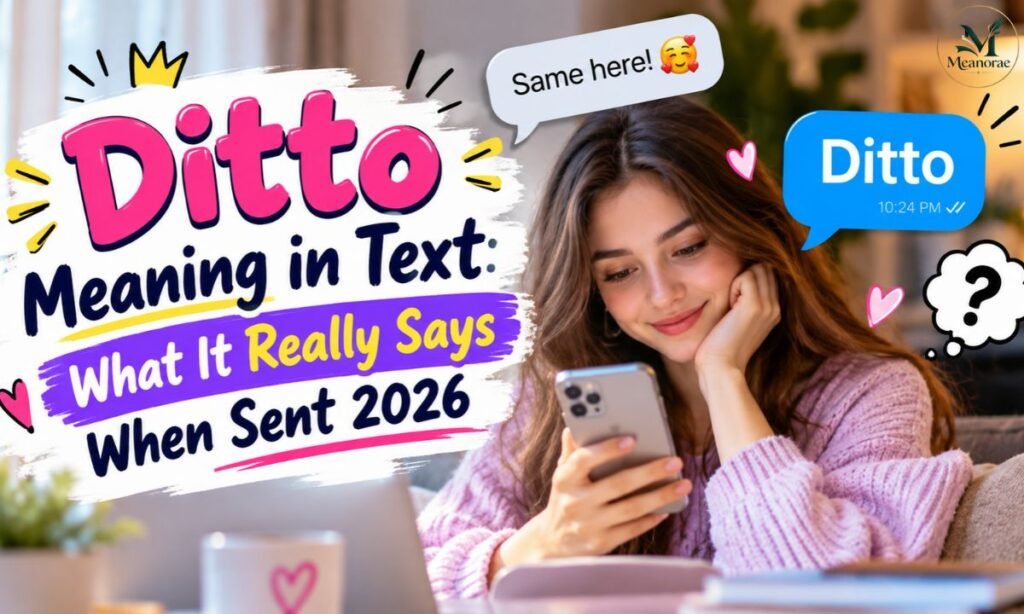
Ditto in text means “same here” or “me too.” You send it to agree with someone or to return a feeling without typing it all again.
Below, you’ll see how the word works in friendly chats, romantic messages, and online posts. You’ll also get its origin, a few similar terms, and replies that fit.
Meaning & Definition
Ditto is an informal word for “the same” or “as already said.” Dictionaries list it as an adverb, a noun, and a verb.
What Does DITTO Meaning in Text?

Ditto in text means “same here,” “me too,” or “I feel the same.” You use it to agree with a message or return a feeling without repeating the words. Someone texts “I’m exhausted,” and you reply “Ditto.” It works as a quick, casual echo of what the other person just said.
The word fits opinions, moods, and plans. A friend writes “That movie dragged,” and your “Ditto” says you felt it too. It saves time, and it also tells the sender you read the message.
Ditto meaning in text in english
In English, ditto means “the same as what was just stated.” People use it as a one word reply that borrows the sender’s exact sentiment.
Think of it as a verbal copy and paste. You skip the retyping, yet the other person still gets your full answer.
What does ditto mean in a relationship

In a relationship, ditto usually means “I love you too” or “I feel the same.” Partners often use it as a playful reply to affection. The 1990 film Ghost made this use famous, because Sam answers Molly’s “I love you” with a single word.
The word itself doesn’t carry the love. Tone and timing do. Some people find a bare “ditto” sweet and teasing, while others read it as a dodge, so a few extra words can help when the moment matters.
Ditto meaning me too

“Me too” is the plainest translation. It matches a statement, a feeling, or a habit.
Picture this exchange. “I’m starving.” “Ditto.” Ditto works best after statements. It sounds odd after a question like “Want pizza?” where a simple yes fits better.
Ditto meaning back at you
Ditto also means “back at you” when someone sends a wish or a kind word. You return it unchanged.
Someone writes “Have a great weekend!” and you answer “Ditto!” The difference is small. “Me too” matches what a person feels, while “back at you” hands their wish back to them.
Background / Origin
Ditto comes from Italian, where detto means “said.” Reference works link that Italian term to the Latin verb dicere, “to say.” English began using ditto as a noun around 1678, according to Merriam-Webster’s record of first known use.
Early English speakers used it to avoid repeating words in lists and accounts. A 1759 cookbook line reads “Parsley roots, and leaves of ditto,” which shows the old sense of “the aforesaid.” By the 1770s, people also used ditto as a spoken verb that meant agreeing with someone.
The copy machine may have added to its modern feel. The Ditto machine was a brand of spirit duplicator used for making paper copies. Some writers suggest this strengthened the idea of ditto as a copy of what came before, though the agreement sense existed long before those machines.
Usage in Different Contexts
Ditto stays casual everywhere. Context changes how warm or breezy it sounds.
- Friends and family: It works as a fast, friendly agreement.
- Romantic partners: It often replies to affection, and tone decides how it lands.
- Work chats: It suits quick replies among teammates, but formal emails call for “likewise” or “I agree.”
- Lists and notes: People write it, or the ditto mark, to avoid repeating an item.
DITTO Meaning on Social Media Platforms
On WhatsApp, Instagram, Snapchat, or in comment sections, ditto keeps the same meaning. It says “same” or “me too.” Research turned up no special platform slang attached to the word.
Music gave it a fresh online life, though. NewJeans released a song called “Ditto” on December 19, 2022, and TikTok users reportedly helped push it up the charts. A comment that quotes the song title can point to the group, but the word itself still means “same.”
Other Meanings in Different Fields
Ditto has several unrelated uses beyond texting. This table separates them.
| Field | Meaning |
| Writing and lists | The ditto mark (″) signals “same as above” |
| Printing | Ditto machine, a brand of spirit duplicator |
| Verb use | To repeat or copy a statement or action |
| Games | Ditto, a Pokémon that transforms into other Pokémon |
| Music | Songs titled “Ditto” by NewJeans (2022) and by Cassie (2006) |
Examples of DITTO Meaning in Text in Sentences
Here are two realistic exchanges.
Friend A: “Mondays should be illegal.”
Friend B: “Ditto. I needed coffee at 7 a.m.”
Partner A: “Miss you already.”
Partner B: “Ditto, and I mean it.”
The second reply adds a few words. That small extra makes the message feel warmer.
Common Misconceptions
Many people think ditto always means “I love you.” It doesn’t. The meaning comes from context, and the romantic reading grew from a movie scene.
Another myth says ditto is modern internet slang. In truth, the word is centuries old. Some also treat it as rude, but it isn’t rude by itself. A cold tone can make it feel that way.
Similar Terms & Alternatives
Several phrases do the same job. Common choices include “me too,” “same here,” “likewise,” “back at you,” “agreed,” and “I concur.” Each carries a slightly different tone, from playful to formal.
How to Respond to DITTO Meaning in Text When Someone Uses It
Match the mood of the message. If a friend sends “ditto,” a simple “Ha, same” keeps things light. If a partner sends it after you say “I love you,” try “Love you more” or “Right back at you.”
You can also ask when the meaning feels unclear. A quick “Ditto to what part?” clears it up without any awkwardness.
Difference Between DITTO Meaning in Text and Similar Terms
| Term | Best use | Tone |
| Ditto | Echo a statement or feeling | Casual, playful |
| Me too | Share the same experience | Casual |
| Same here | Match a situation or opinion | Casual |
| Likewise | Return a polite wish | Polite, neutral |
| Back at you | Return a greeting or kind word | Friendly |
Relevance in Online Conversations & Dating Apps
Fast chats reward short replies, so ditto fits naturally. It keeps the conversation moving, and it sounds relaxed.
Dating apps add a wrinkle. A one word answer can feel flat when someone shares something long or vulnerable. Add a few words, such as “Ditto, and I’m glad you said it,” if you want the reply to land warmly.
Explore More Meaning Guide: OMW Meaning in Text: What It Really Means & How to Reply 2026
Conclusion
Ditto means “the same,” and in text it works as “me too” or “back at you.” In romantic chats, it often stands in for “I love you too.”
Tone and context shape how it reads. Pair it with a few extra words when the message matters.
Frequently Asked Questions
Does ditto mean I love you?
Not literally. Ditto means “the same,” but replying to “I love you” with it usually means “I love you too.”
Is ditto rude to say in a text?
Not by itself. It can feel curt if the other person shared something heartfelt, so add a few words in that case.
Can I use ditto in a work message?
Yes, in casual chats with coworkers. Formal emails read better with “likewise” or “I agree.”
What is a ditto mark?
A ditto mark (″) is a symbol that means “same as above.” People use it in lists and tables to avoid repeating an entry.
Is ditto still used today?
Yes, people still use it in casual texts and speech. Some may find it a little old school, but nobody will misunderstand it.

Abdul Rehman is the author at Meanorae, sharing clear and helpful insights into meanings of words, names, phrases, and expressions for curious readers.


Pingback: What Does BBG Mean? Texting, Dating & Gym Meanings 2026
Pingback: NSFW Meaning in Text: What It Really Means in 2026
Pingback: GMA Meaning in Text: What It Really Stands For in 2026
Pingback: TMW Meaning in Text: What Does TMW Really Mean in 2026?
Pingback: What Does HYD Stand for in Texts and Online Chats? 2026
Pingback: EMP Meaning in Text from a Girl: Definition & Examples (2026)
Pingback: RS Meaning in Text: Definition, Uses & Examples (2026)
Pingback: MIA Meaning in Text Messages and Social Media (2026)
Pingback: HM Meaning in Text: Definition, Uses & Examples (2026)
Pingback: WS Meaning in Text: Definition, Uses & Examples (2026)